Singapore is significantly expanding support for families, with parents set to receive more childcare leave, sustained financial assistance until their children turn 17, cheaper preschool fees and better chances when applying for public housing.
The measures, announced by Prime Minister Lawrence Wong at the National Day Rally 2026, represent a broader shift in Singapore’s marriage and parenthood policies.
Instead of concentrating assistance mainly around childbirth and a child’s early years, the new measures are designed to provide support across much more of the parenting journey.
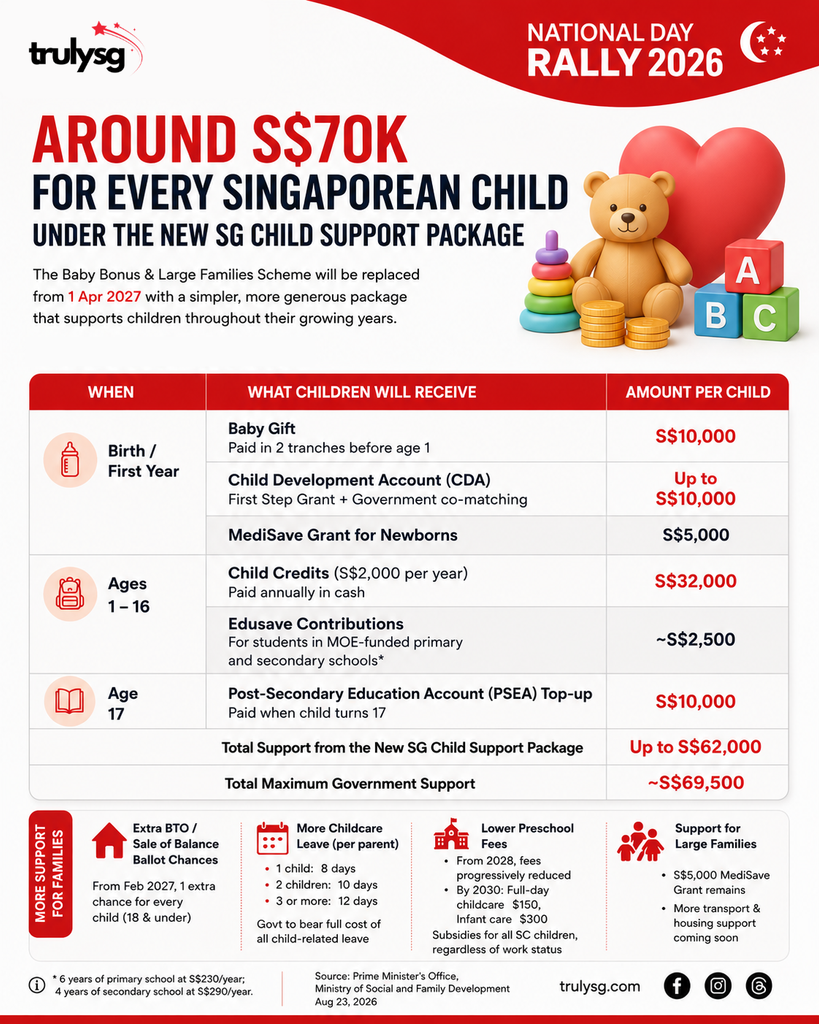
One of the biggest changes is the introduction of the SG Child Support Package, which will provide up to S$62,000 for every eligible Singapore Citizen child, regardless of birth order.
Importantly, much of the support will not be limited to babies born after the new scheme begins. Existing Singapore Citizen children within the eligible age groups will also benefit from parts of the package.
Up to S$62,000 under the new SG Child Support Package
The existing Baby Bonus Scheme and Large Families Scheme will be replaced by the SG Child Support Package.
Under the new system, every eligible Singapore Citizen child will receive the same baseline level of support regardless of whether he or she is the family’s first, second or subsequent child.
The package comprises:
| Support | Amount |
|---|---|
| Baby Gift | S$10,000 |
| Child Credits | S$32,000 |
| CDA First Step Grant | S$5,000 |
| Government CDA co-matching | Up to S$5,000 |
| PSEA top-up at age 17 | S$10,000 |
| Maximum SG Child Support Package | S$62,000 |
The largest component is the new S$32,000 Child Credits.
Instead of receiving the entire amount upfront, families will receive S$2,000 in cash each year for 16 years, from the year the child turns one until the year the child turns 16.
This effectively creates a recurring stream of financial support throughout much of a child’s growing years rather than concentrating cash benefits mainly around birth and early childhood.
Around S$70,000 when existing benefits are included
The S$62,000 figure does not include every form of direct government financial support available to a child.
Singapore Citizen children also receive the existing S$5,000 MediSave Grant for Newborns, while annual Edusave contributions during primary and secondary school add up to about S$2,500 for students in MOE-funded schools.
Taken together, the Government estimates that an eligible Singapore Citizen child will receive around S$70,000 in direct financial support from birth to age 17.
The distinction is important: S$62,000 refers specifically to the maximum value of the SG Child Support Package, while the approximately S$70,000 figure includes the MediSave grant and Edusave contributions.
Existing children will benefit too
Another significant feature is that the new package is not restricted entirely to future newborns.
The Government said it will extend benefits to existing Singapore Citizen children born in or turning ages one to 17 in 2026, with the amount they receive depending on their age and which components remain applicable.
For example, children turning between one and 16 in 2026 will receive S$2,000 in 2026 Child Credits by 30 April 2027.
Children turning 17 in 2026, meanwhile, will receive the S$10,000 PSEA top-up in June 2027.
For babies, the transition works differently. Children born on or after 1 April 2027 will receive the new S$10,000 Baby Gift in two tranches before turning one.
Children born earlier who are still receiving Baby Bonus Cash Gift payouts will continue receiving them until 31 March 2027, with a top-up where applicable to bring their total support to S$10,000.
Parents to get 8, 10 or 12 days of childcare leave
Financial assistance is only one part of the changes.
The current Childcare Leave (CCL) and Extended Childcare Leave (ECL) arrangements will eventually be merged into a single childcare leave scheme covering working parents with Singapore Citizen children aged 12 and below.
The number of days will depend on how many eligible children a parent has:
| Singapore Citizen children aged 12 and below | Childcare leave per working parent each year |
|---|---|
| 1 child | 8 days |
| 2 children | 10 days |
| 3 or more children | 12 days |
Currently, a working parent whose youngest Singapore Citizen child is six or younger generally receives six days of childcare leave annually. When the youngest child is aged seven to 12, the entitlement is two days of Extended Childcare Leave.
The new arrangement therefore does more than increase the number of leave days. It also removes the existing distinction based on the age of the youngest child and instead links the entitlement to the number of eligible children aged 12 and below.
The implementation date has not yet been announced.
Government to bear the cost of all child-related leave
Employers will also see a substantial change.
The Government intends to reimburse employers for the full duration of child-related leave schemes, subject to the applicable reimbursement limits.
At present, employers bear part of the cost of certain leave entitlements. For example, the Government does not currently reimburse the first eight weeks of the 16-week Government-Paid Maternity Leave for the first and second child, or the first three days of the existing six-day Childcare Leave.
Under the new arrangement, government coverage will extend across child-related leave schemes including maternity, adoption, paternity, shared parental and childcare leave.
The change is intended to reduce the direct financial burden on employers when workers take their statutory family-related leave.
Childcare fees targeted to fall to S$150 a month by 2030
Families with younger children will also see changes to preschool costs.
Full-day fees for Singapore Citizen children at Government-supported centres are targeted to fall to:
- S$150 a month for childcare
- S$300 a month for infant care
The reductions will begin progressively from 2028, with the target fee levels expected to be reached by 2030.
These figures are before means-testing, meaning lower-income households may pay even less.
The Government also plans to extend full childcare and infant care subsidies to families with Singapore Citizen children regardless of the working status of the main subsidy applicant.
Currently, access to full preschool subsidies generally requires the main subsidy applicant to work at least 56 hours a month.
Further implementation details are expected in early 2027.
More infant care and student care places planned
Affordability is only part of the preschool push.
The Government will expand the network of Government-supported preschool operators and provide additional support for eligible operators that want to join the network.
More infant care spaces are also planned, alongside an expansion of the infant educator workforce.
Support will extend into the primary school years as well, with plans to increase student care capacity, improve care quality and keep fees affordable at student care centres in primary schools.
Selected centres outside schools will also be involved to give parents more options.
Each child could improve a family’s BTO chances
Families looking for a new home will receive another form of support from the February 2027 BTO and Sale of Balance Flats exercises.
First-timer families with children — or expecting a child — will receive one additional ballot chance for every Singapore Citizen child aged 18 and below.
This means the benefit increases with family size.
A first-timer family with one eligible child would receive one additional ballot chance, while a family with three eligible children would receive three additional chances.
The measure will apply to both BTO and SBF applications.
What happens to support for large families?
The move towards equal baseline support for every child also changes how assistance for larger families is structured.
Under the existing system, third and subsequent children receive additional benefits through the Large Families Scheme.
The new SG Child Support Package instead gives the same baseline package to every birth order. This means the first and second children in a large family will also benefit from the enhanced support.
The existing S$1,000 annual Large Family LifeSG Credits for third and subsequent children, paid for six years, will effectively be superseded by the much broader Child Credits: S$2,000 annually for 16 years and available across all birth orders.
However, this does not mean targeted large-family support will disappear entirely.
The Government is studying additional measures covering healthcare, transport and housing for families with three or more children, including how the existing S$5,000 Large Family MediSave Grant could be repositioned and extended.
Details have yet to be announced.
A shift from supporting births to supporting childhood
Taken together, the NDR 2026 measures point to an important change in how Singapore approaches family support.
The previous system placed substantial emphasis on the financial costs surrounding childbirth and the early childhood years. The new approach stretches a larger portion of assistance across childhood and adolescence.
The S$32,000 Child Credits illustrate this most clearly: rather than a one-off payment, parents receive recurring cash support every year until their child turns 16.
The extension of childcare leave to parents of children up to age 12, the eventual reduction in preschool fees, expansion of student care and the S$10,000 PSEA top-up at age 17 similarly extend support across different stages of raising a child.
There are, however, several details families will still need to watch.
The commencement date for the new childcare leave system has not been announced, preschool fee reductions will only begin progressively from 2028, and further measures for large families remain under study.
The Marriage & Parenthood Reset Workgroup is expected to release a fuller set of recommendations in early 2027, including further work relating to work-life support, fertility and maternity health, relationship formation and education.
Source: Prime Minister’s Office and Ministry of Social and Family Development, Marriage & Parenthood Measures at National Day Rally 2026, 23 August 2026.