

An employer says your job is ending, then offers you a resignation letter to sign. Before you agree, ask three questions: who is ending the employment, what reason is being given, and how has the exit payment been calculated?
Those answers help you assess the paperwork. A redundancy, a performance dismissal and a voluntary resignation can involve different notice arrangements, payments and dispute options. The heading on a letter is only a starting point.
Here is how to check an exit proposal in Singapore, including what to request in writing before signing.
This guide concerns employees covered by the Employment Act. It covers local and foreign employees under a contract of service, with exceptions including domestic workers, seafarers, civil servants and statutory board employees. Check MOM’s coverage guidance if you are unsure. This is general information, not advice on an individual dispute.
Start With The Reason Your Employment Is Ending
“Fired” is everyday language. It does not, by itself, tell you whether an employer alleges misconduct, cites poor performance or simply invokes a contractual termination clause.
| Situation | What It Means | What To Check |
|---|---|---|
| Retrenchment | Employment ends because of redundancy or reorganisation. | Notice arrangements, the benefit provision and the payout calculation. |
| Poor performance | The employer says your work fell below the required standard. | The supporting evidence and notice or salary in lieu. |
| Misconduct | The employer alleges a disciplinary breach. | The allegation, inquiry and opportunity to respond. |
| Asked to resign | The employer proposes that you submit a resignation. | Whether you choose to leave voluntarily and what the proposed terms say. |
A proposal can contain several elements, such as a resignation and a negotiated payment. Ask for the complete terms so you can assess them together.
Retrenchment: Check The Benefit Provision, Not Just The Package Total
MOM defines retrenchment as dismissal because of redundancy or reorganisation. Its guidance also presumes retrenchment where an employer terminates a contract without plans to fill the vacancy soon. Calling the letter a “termination” does not settle the underlying reason.
Under MOM’s responsible retrenchment guidance, employees with at least two years’ service are eligible for retrenchment benefits. Those with shorter service may receive an ex-gratia payment out of goodwill. The prevailing norm is between two weeks and one month of salary for each year of service.
However, MOM clarifies that retrenchment benefits are not generally mandated by law. The amount depends on contractual provisions or an applicable agreement; where none exists, it must be negotiated. The two-year benchmark and usual payout range are not an automatic statutory formula guaranteeing every employee a particular sum.
Request the relevant contract clause, collective agreement or written offer. Then ask which salary figure, service period and treatment of incomplete years were used. A package described as “three months’ pay” is hard to assess until you know what it includes.
Employers with at least 10 employees must notify MOM within five working days after informing an affected employee of retrenchment. This is the employer’s reporting obligation, separate from your decision about the package.
Poor Performance And Misconduct Have Different Requirements
The Tripartite Guidelines on Wrongful Dismissal say poor performance does not justify dismissal without notice. If an employer cites poor performance, it must substantiate that reason and provide notice or salary in lieu.
Ask which targets, reviews or incidents support the decision. If you disagree, identify the particular record you dispute and keep your response factual. Do not assume the absence of a performance improvement plan alone settles whether the dismissal was wrongful.
Misconduct has a different process. MOM says employers must conduct a formal inquiry before taking disciplinary action. Its guidance calls for the employee to know the allegation, have a chance to present their case, and have the matter heard by someone whose position does not suggest bias.
If the inquiry establishes misconduct, the employer may dismiss the employee without notice or salary in lieu. An allegation should therefore be addressed through the inquiry rather than treated as an established finding from the outset.
For example, ask whether the issue is a missed sales target or an allegation that records were falsified. Request the precise allegation and the documents you need to respond to it.
Asked To Resign: Clarify Whether You Are Choosing To Leave
Singapore’s dismissal framework includes involuntary resignation. A signed resignation letter does not necessarily settle whether the departure was voluntary.
Equally, a request to resign does not automatically establish wrongful dismissal. The circumstances and evidence matter. If you are uncertain, ask for time to review the proposal and seek advice before signing a resignation or settlement.
Useful questions for HR include:
- Is the company terminating my employment, or offering me an option to resign?
- What happens if I decline the resignation proposal?
- What last day, notice arrangement and payment apply to each option?
- Does the proposed agreement include a release of claims, repayment obligation or confidentiality clause?
After a meeting, write down the date, attendees and what was said. Send a calm email requesting confirmation of the proposed terms. Keep your employment contract, payslips, relevant messages and performance records that you are entitled to retain.
A statement that resignation will “look better” leaves important questions unanswered. Ask what the employer will record and what reference it proposes to provide, alongside the financial terms.
Separate Final Salary, Notice Pay And Retrenchment Benefits
Ask for an itemised statement rather than accepting a single package figure. Use these headings to check for omissions or double counting.
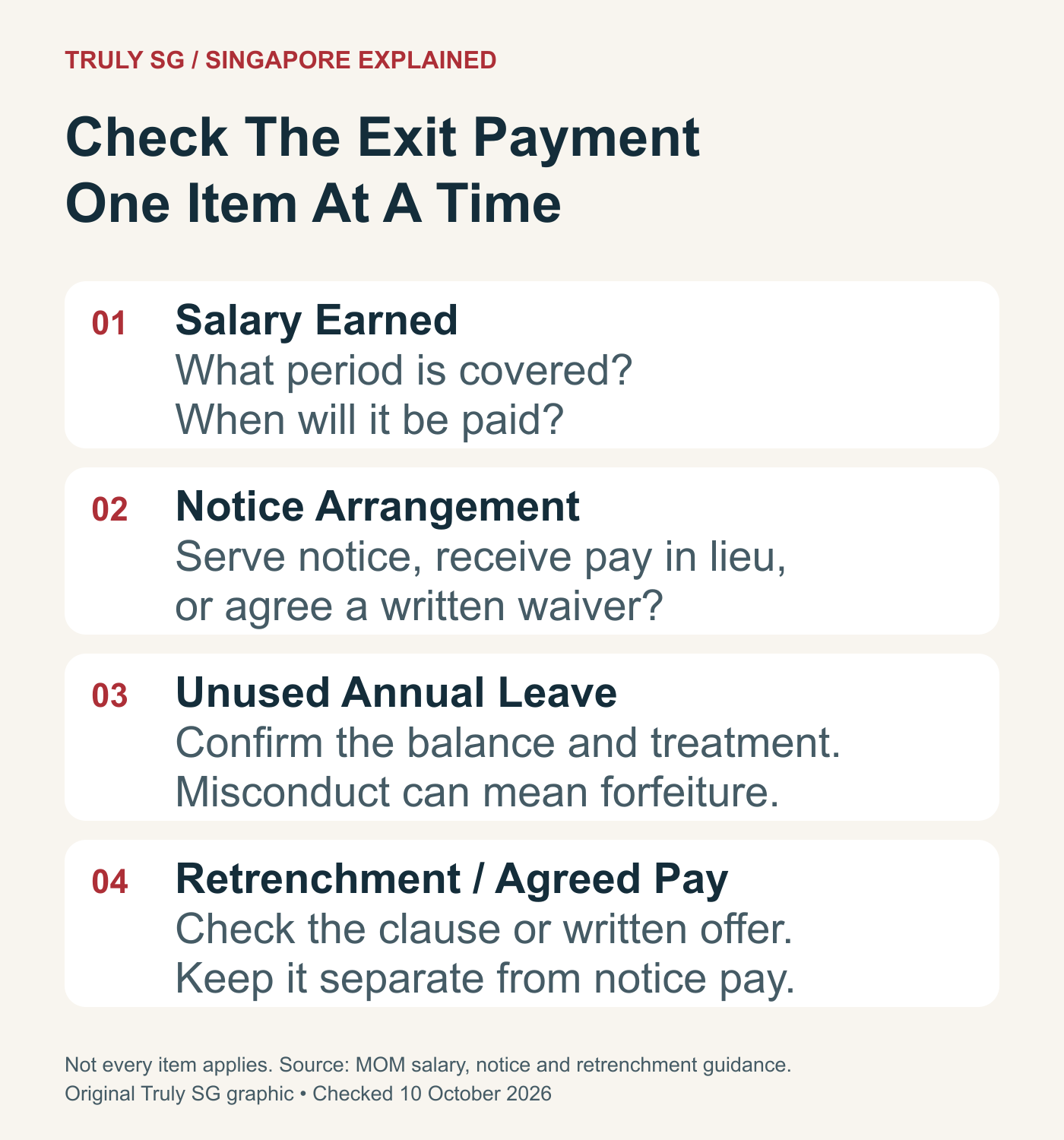
Salary earned: confirm the period covered, any outstanding salary and the payment date. Under MOM’s salary guidance, an employer-initiated termination generally requires final salary on the last day, or within three working days if payment that day is not possible. A resignation with the required notice requires payment on the last day; resignation without serving notice requires payment within seven days.
Foreign employees may be subject to tax-clearance withholding. Commission payment timing depends on the contract or existing policies or practices.
Notice: check the contractual period, who is ending employment, and whether notice will be served, paid in lieu or waived by mutual agreement. MOM says termination notice must be in writing. A resignation may require you to serve notice or pay salary in lieu unless it is waived.
Unused annual leave: MOM’s notice guidance says unused leave must be paid at the gross rate based on the last drawn salary when employment is terminated other than for misconduct. Misconduct dismissal can result in forfeiture. Check the recorded balance and treatment of any contractual leave above statutory entitlement against MOM’s leave guidance and your contract.
Retrenchment or other agreed payments: ask HR to identify the provision or offer supporting each amount, and distinguish it from salary and notice pay. Check any bonus against the applicable terms rather than assuming it is included.
For a simple arithmetic check, suppose a written offer promises a separate S$8,000 retrenchment payment and S$4,000 salary in lieu of notice. Those two components total S$12,000 before other items. If the document instead says S$8,000 “inclusive of notice pay”, it does not promise S$12,000. This is an illustrative example, not a statutory payout calculation.
If The Contract Has No Notice Period
MOM sets the following default periods where the contract does not specify notice:
| Length Of Service | Default Notice |
|---|---|
| Less than 26 weeks | 1 day |
| 26 weeks to less than 2 years | 1 week |
| 2 years to less than 5 years | 2 weeks |
| 5 years or more | 4 weeks |
Check your contract first. Record any waiver in writing.
Suspect Wrongful Dismissal? Act Early
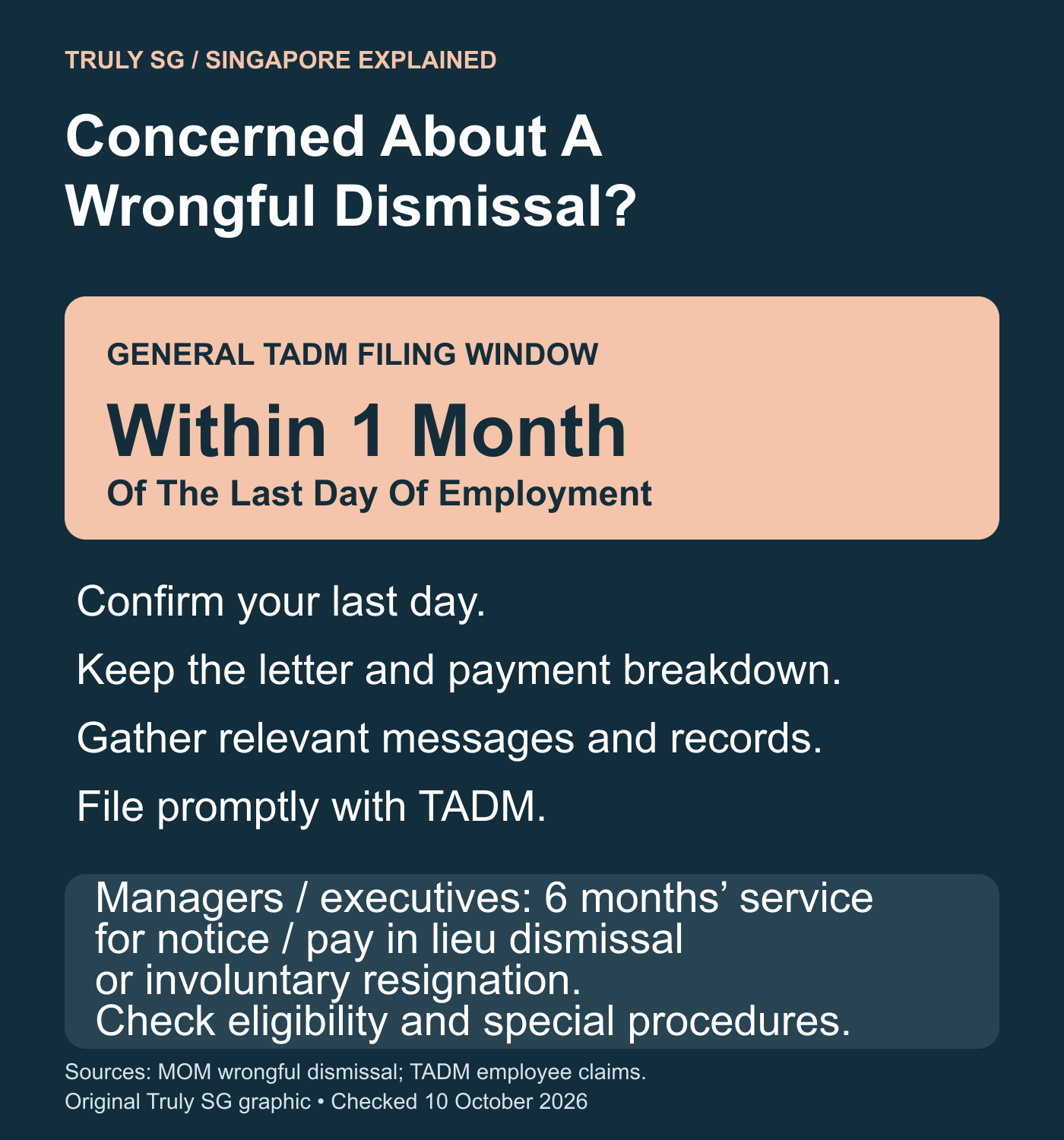
TADM’s filing guidance gives a general wrongful dismissal claim deadline of one month after the last day of employment. Managers and executives dismissed with notice or salary in lieu, or who resign involuntarily, must have at least six months’ service to submit a claim.
Wrongful reasons can include discrimination, depriving someone of an employment benefit or punishing them for exercising an employment right. Paying notice does not automatically make every dismissal lawful.
Conversely, an employer is not generally required to give a reason for contractual termination with notice. The tripartite guidelines presume such dismissals are not wrongful; where no reason is given, an employee alleging wrongdoing must substantiate a wrongful reason. If misconduct or poor performance is cited, the employer must prove that ground. A reason proven false can also make a dismissal wrongful.
Prepare a short chronology: what happened, on which dates, who communicated the decision, and which documents support your concern. Bring both the resignation or termination paperwork and the proposed payment breakdown.
Use TADM’s services, approach your union if you are a member, or seek legal advice. MOM provides a separate maternity-related route for wrongful dismissal during pregnancy where maternity benefits have not been paid, with filing after dismissal and within two months of the child’s birth. Ask promptly about eligibility and the correct route for maternity, retirement-age or re-employment disputes. Do not assume HR discussions extend a deadline.
Before signing, aim to have a written answer to four practical questions: why employment is ending, whether you are choosing to resign, how notice is handled, and exactly what will be paid.
Sources
- MOM: Employment Act coverage.
- MOM: Responsible retrenchment and retrenchment benefit clarification.
- Tripartite Guidelines on Wrongful Dismissal, first published on 23 July 2024.
- MOM: Misconduct inquiries, termination with notice and wrongful dismissal claims.
- MOM: Paying salary and annual leave in special situations.
- TADM: Employee claims and eligibility and MOM: Maternity leave disputes.
⚡Top 3 Personal Loan Promotions in Singapore. T&Cs apply.