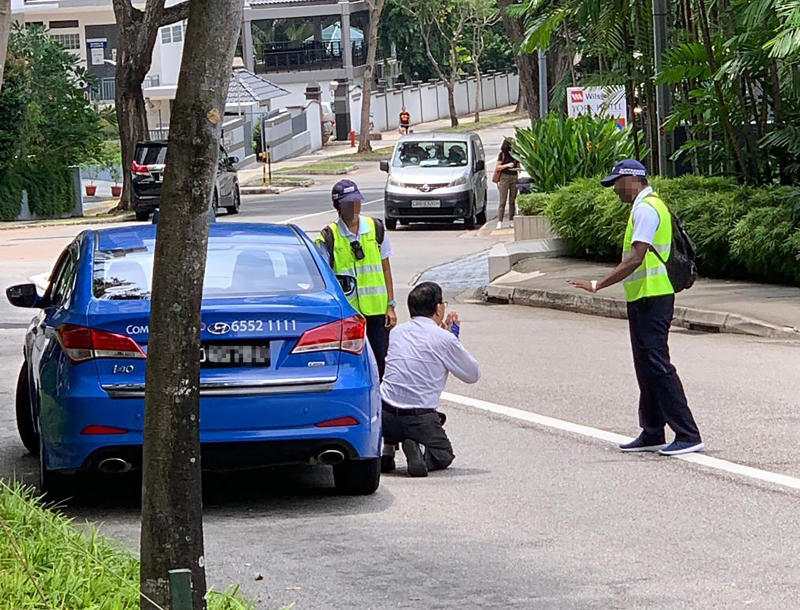
In 2019, a ComfortDelgro cabby was captured on his knees, begging officers for mercy after being slapped with a $200 fine by the National Environment Agency for smoking in his own taxi, a moment that laid bare the precarious existence of Singapore’s taxi drivers.
Under the Smoking (Prohibition in Certain Places) Act, anyone caught smoking in a prohibited place or a public service vehicle may face a composition fine of $200, or up to the maximum court fine of $1,000. While the law applies equally to all, its impact falls disproportionately on those for whom such penalties represent not just punishment, but potential ruin.
The taxi driver’s desperate plea on the asphalt captures a harsh reality faced by thousands who depend on their steering wheel for survival.
For these drivers, every summons isn’t just a penalty. It’s a crushing blow that can unravel days of grueling 12-hour shifts spent navigating Singapore’s streets. That $200 fine represented nearly two full days of income wiped away, making the officer’s citation not merely a regulatory matter but a potential family crisis.
Each fine represents meals taken from their family’s table, school fees delayed, medical bills unpaid. The mathematics are merciless: a single violation can erase an entire day’s earnings, sometimes more. Hours spent battling traffic, enduring passenger complaints, and sacrificing time with loved ones, all rendered meaningless in an instant.
These drivers operate without the safety nets that others take for granted. No sick leave cushions them when illness strikes. No annual bonuses supplement lean months. Every hour off the road is income lost forever, creating an unforgiving cycle where stopping isn’t an option, yet one moment of poor judgment, even in the privacy of their own vehicle between fares, can trigger financial catastrophe.
Behind each taxi meter lies a family’s hopes, their rent, their next meal. When an officer approaches with a summons book, it’s not just a traffic violation being recorded. It’s the potential collapse of carefully balanced budgets, the anxiety of explaining to children why this month will be harder than the last.
This is the precarious edge where Singapore’s most vulnerable workers live daily, where dignity meets desperation on the very roads they call their livelihood.
Between mercy and the rulebook: When one image sparked Singapore’s most heated debate
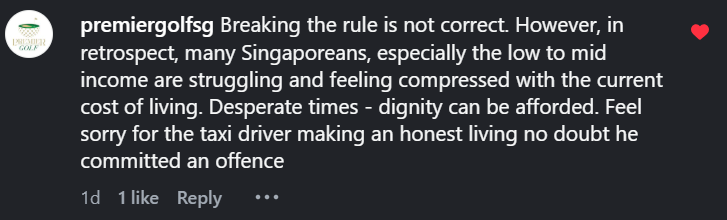
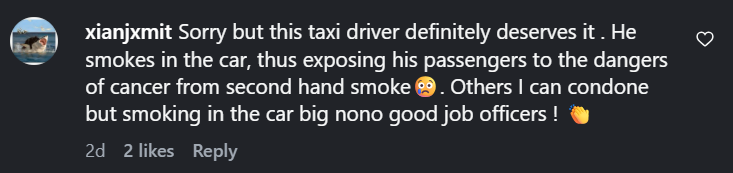
Public reaction split sharply along two fault lines. Supporters of the driver called for greater empathy from enforcement officers, arguing that authorities should consider the financial devastation such fines inflict on those living paycheck to paycheck.
Others maintained that laws exist for public health and safety, and that selective enforcement based on economic circumstances would undermine the rule of law and create dangerous precedents.
The post which was published on Truly SG’s Instagram on 18 December 2025 has since garnered more than 1,000,000 views and over 200 comments from Singaporeans as of 21 Dec 2025.






List of Places Where Smoking is Prohibited
According to NEA’s website, it is an offence for a person to smoke in smoking prohibited areas listed under the Smoking (Prohibition in Certain Places) Regulations 2018.
1. If you are within a building or public service vehicle, it is largely not permitted to smoke except at indoor smoking rooms and uncovered areas on the rooftops of multi-storey carparks. This includes any common properties within any residential building, atrium, courtyard, common corridor, lifts, lobby, void deck, and stairwell.
2. If you are outside a building or public service vehicle, the following are also smoking prohibited:
- Everywhere around the hospital compounds
- Educational institutions and their compounds including any area within five metres of the school compound
- Covered linkways
- Bus stops, bus shelters, and bus poles, including any area within a five metre radius
- Parks in public housing estates managed by the respective Town Councils
- Parks under the purview of JTC Corporation
- Playgrounds and exercise areas, including adjacent amenities for users
- Reservoirs; Active, Beautiful, Clean Waters (ABC Waters) Sites; 10 Recreational Beaches*; Parks and Gardens
- Swimming pools, including changing and shower rooms or areas for users of the swimming pool and areas within five metres of the swimming pool.
- Pavilions within any residential premises meant to hold functions
- Pedestrian overhead bridges, covered or underground walkways
- Washrooms, including mobile toilets
- Public areas within the Orchard Road precinct designated as a No Smoking Zone
Any area within five metres of ventilation intakes, external windows, openings, entrances, and exits to buildings of commercial, industrial or recreational purposes or publicly accessible where smoking is prohibited
Please note that smoking is also prohibited at all parks, gardens and nature reserves managed by National Parks Board.
The bottom line
Perhaps the real value of this viral moment lies not in determining who was right or wrong, but in what it revealed about the precarious edges of our society. It challenged us to look beyond headlines and see the human cost of policies applied uniformly across vastly unequal circumstances. It asked whether justice must always be blind to context, or whether true fairness sometimes requires seeing more, not less.
The taxi driver may have eventually paid his fine and returned to the roads and the regulations remain unchanged. But the conversation his plea ignited endures, a reminder that behind every enforcement action, every penalty issued, stands a person whose story we may never fully know.
For those seeking information about smoking prohibition zones in Singapore, details are available on the NEA website. Understanding the rules is the first step. Understanding the lives affected by them may be the more difficult, but necessary, journey.
This is Truly SG 🇸🇬
Sources: Straits Times, Singapore Statues Online, National Environment Agency